Description & Call for Papers
Conference Overview
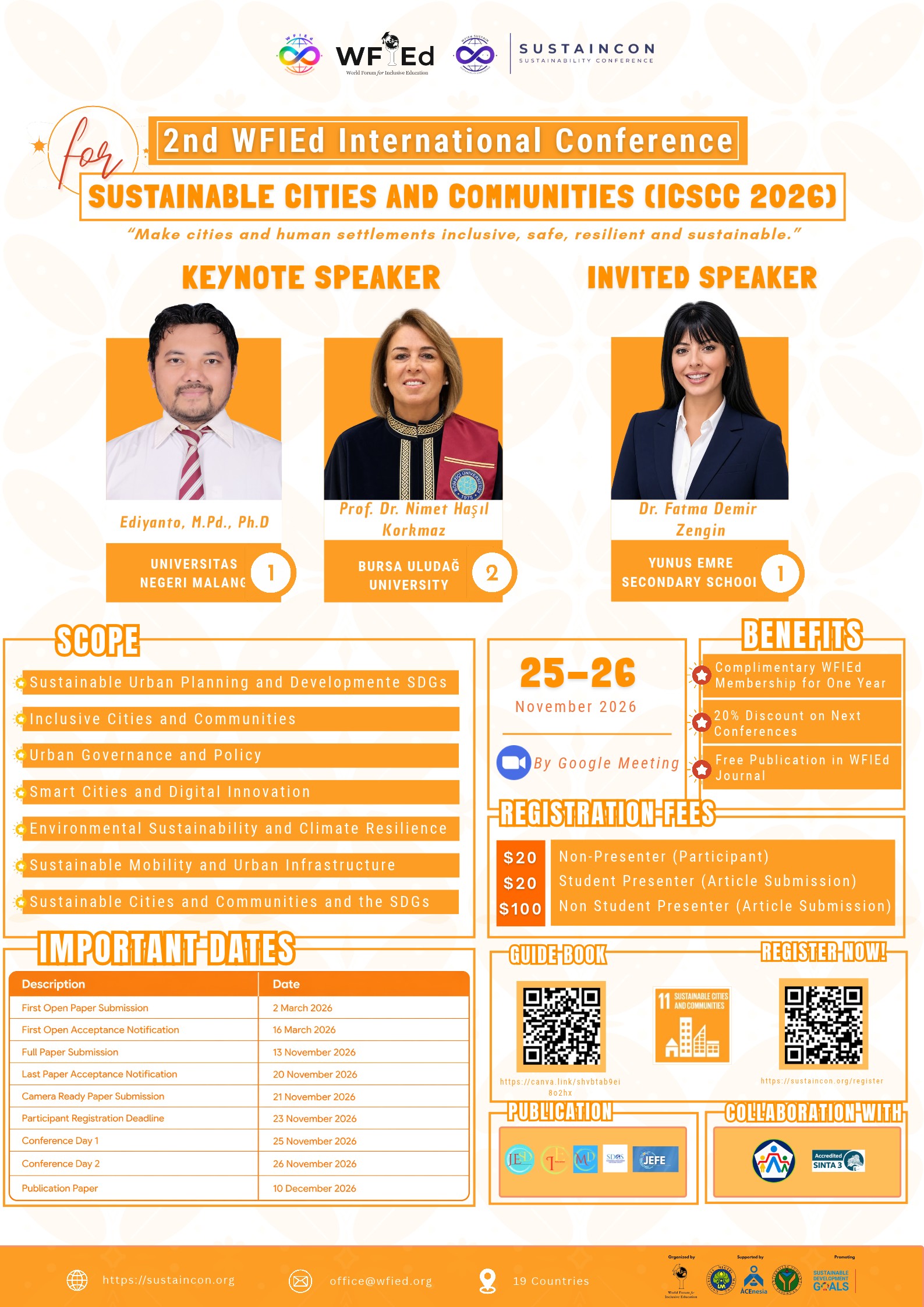
The 2nd WFIEd International Conference for Sustainable Cities and Communities is an international academic forum dedicated to advancing knowledge, innovation, policy, and practice for creating cities and human settlements that are inclusive, safe, resilient, and sustainable.
The conference responds to growing challenges associated with urbanization, inequality, environmental pressures, climate change, infrastructure development, and the need to improve social well-being across diverse urban and community contexts. Particular attention is given to rapidly urbanizing regions, developing and emerging contexts, and resource-constrained communities.
Bringing together perspectives from academia, policy, and practice, the conference provides a platform for interdisciplinary dialogue on sustainable urban planning, inclusive communities, housing and human settlements, urban governance, smart and resilient cities, community participation, environmental sustainability, sustainable mobility, and disaster risk reduction. The conference is primarily aligned with SDG 11 — Sustainable Cities and Communities, while recognizing the interconnected nature of sustainable urban development with other Sustainable Development Goals.
Conference Objectives
The conference aims to:
1. Facilitate international dissemination and exchange of research on sustainable cities and communities.
2. Promote interdisciplinary dialogue on inclusive, safe, resilient, and sustainable human settlements.
3. Strengthen connections between research evidence, urban policy, and professional practice.
4. Encourage collaboration among researchers, policymakers, practitioners, communities, and other stakeholders.
I6. dentify innovative and context-responsive approaches to contemporary urban and community challenges.
6. Contribute to the implementation and advancement of SDG 11 — Sustainable Cities and Communities and related SDGs.
Call for Papers
The conference invites researchers, academics, policymakers, practitioners, and students to submit original scholarly contributions related to the theme “Make cities and human settlements inclusive, safe, resilient and sustainable.” Contributions should advance understanding, policy, innovation, or practice related to sustainable urban and community development across diverse sociocultural, economic, environmental, and institutional contexts. The conference welcomes original empirical research, conceptual papers, systematic or scoping reviews, case studies, methodological studies, policy studies, and innovation or practice-based papers. Interdisciplinary and cross-sector contributions that connect research with real-world urban and community challenges are particularly encouraged.
Thematic Scope
Submissions may address, but are not limited to, the following themes:
1. Sustainable Urban Planning and Development
* Urban planning for sustainability and resilience
* Land use, spatial planning, and urban growth
* Inclusive and people-centered city design
* Urban development in developing and emerging contexts
2. Inclusive Cities and Communities
* Social inclusion and equity in urban settings
* Housing, informal settlements, and urban poverty
* Accessibility for persons with disabilities and older persons
* Gender-responsive and child-friendly cities
3. Urban Governance and Policy
* Local governance and sustainable city management
* Participatory planning and community engagement
* Urban policy and regulatory frameworks
* Financing sustainable urban development
4. Smart Cities and Digital Innovation
* Smart city technologies and digital infrastructure
* Data-driven urban management
* Digital inclusion and smart governance
* Technology for sustainable urban services
5. Environmental Sustainability and Climate Resilience
* Climate adaptation and mitigation in cities
* Urban green spaces and biodiversity
* Sustainable waste, water, and energy management
* Resilient cities and disaster risk reduction
6. Sustainable Mobility and Urban Infrastructure
* Public transportation and sustainable mobility
* Inclusive and accessible urban infrastructure
* Green and resilient infrastructure systems
* Mobility for marginalized and vulnerable populations
7. Sustainable Cities and Communities and the SDGs
* SDG 11 implementation and monitoring
* Integrated approaches to urban sustainability
* Partnerships for sustainable cities
* Best practices and innovations for achieving SDG 11
Who Should Participate?
The conference welcomes:
1. Researchers and academics
2. University lecturers and educators
3. Undergraduate and postgraduate students
4. Policymakers and government representatives
5. Urban planners and professionals
6. Practitioners and industry representatives
7. NGOs and civil society organizations
8. International and development organizations
9. Community leaders and other relevant stakeholders
International, interdisciplinary, and cross-sector participation is strongly encouraged.
Paper & Presentation
Submitted papers will undergo an academic review process. Accepted contributions will be eligible for presentation during the conference in accordance with the conference presentation format and requirements.
Authors of accepted papers are expected to comply with the final-paper requirements and other applicable conference procedures. Specific submission dates, conference dates, and related administrative information are provided separately through the SustainCon conference system.
Publication Opportunities
All papers accepted for presentation at the conference will be eligible for publication in journals managed by the World Forum for Inclusive Education (WFIEd), subject to the applicable editorial and publication requirements.
No additional publication fee will be charged to authors beyond the applicable conference registration fee. This publication opportunity is provided as part of the academic benefits of participating in the conference.
The assignment of accepted papers to the appropriate WFIEd-managed journal will be determined based on the scope and thematic relevance of each manuscript. Authors are required to comply with the respective journal's manuscript preparation, research integrity, and editorial requirements before publication.
The conference and its publication process are committed to maintaining appropriate standards of academic quality, publication ethics, and scholarly integrity.
Conference Impact & SDG Contribution
Primary SDG:
SDG 11 — Sustainable Cities and Communities
Related SDGs:
SDG 5 — Gender Equality
SDG 6 — Clean Water and Sanitation
SDG 7 — Affordable and Clean Energy
SDG 9 — Industry, Innovation and Infrastructure
SDG 10 — Reduced Inequalities
SDG 13 — Climate Action
SDG 17 — Partnerships for the Goals
The conference is expected to contribute primarily to SDG 11 — Sustainable Cities and Communities by strengthening the generation and dissemination of evidence related to inclusive urbanization, sustainable human settlements, resilience, accessibility, urban governance, sustainable infrastructure, environmental management, and community participation.
Through international knowledge exchange, the conference seeks to identify approaches and innovations that can inform research, policy, and practice across different urban and community contexts. Beyond research dissemination, it seeks to strengthen interdisciplinary and cross-sector collaboration among academic institutions, governments, practitioners, communities, civil society, and other stakeholders.
These interactions are expected to support evidence-informed policymaking, encourage transferable innovations and good practices, and strengthen partnerships for achieving sustainable urban and community development.